
People ask about the name. A tattoo studio named after a wrathful Buddhist deity — why? The answer isn't a marketing decision. It's a statement of values, rooted in a tradition that Marcus has been part of since 1991. Understanding who Acala is, and what he represents, goes a long way toward understanding the philosophy behind this studio.
Who Is Acala?
ACALA [ah-kah-lah] (Skr.: Acala, Achala अचल; "immovable" one) is a dharmapala (wrathful deity) primarily revered in Vajrayana Buddhism, particularly in Tangmi in Japan, China and elsewhere. Fudō-myōō (不動明王) is the full Japanese name for Acala-vidyaraja, or Fudō (o-Fudō-sama etc.) for short. It is the literal translation of the Sanskrit term "immovable wisdom king".
Acala is said to be a powerful deity who protects All the Living (sattva, shujō (衆生)) by burning away all impediments (antar-aya, shōnan (障難)) and defilements, thus aiding them towards enlightenment.
The Sanskrit symbol that represents Acala is hāṃ हां (conventionally transliterated kān (kaan) (カーン)). Some of the other transliterations and variants to his name are Ācalanātha, Āryācalanātha, Ācala-vidyā-rāja. The Hindu form of the deity may also be known as Caṇḍamahāroṣaṇa or Caṇḍaroṣaṇa "the violent-wrathful" one.
He is classified among the Wisdom Kings (Myō-O, 明王) — a class of deities in esoteric Buddhism who represent the fierce, wrathful aspect of enlightened wisdom. Acala is preeminent among the Five Wisdom Kings (Godai Myō-O, 五大明王) of the Womb Realm, and his figure occupies a central hierarchical position in the Mandala of the Two Realms.
In Japan, Acala/Fudō is revered across multiple Buddhist schools: Shingon, Tendai, Zen, Nichiren, and in the mountain ascetic tradition of Shugendō. He is one of the most widely worshipped deities in Japanese Buddhism — his image appears in temples, on amulets, in martial arts dojos, and in tattooing. Extreme devotees belong to a cult where Acala/Fudō became an idol of worship in its own right, installed as the gohonzon (本尊) or main deity at temples and outdoor shrines. A famous example is the Narita Fudō, a Shingon subsect temple at Narita-san.
History
Originally the Hindu deity Acalanātha (अचलनाथ), whose name in Sanskrit signifies ācala "immovable" + nātha "protector," Acala was incorporated into esoteric Buddhism (late 7th century, India) as a servant of Buddha. In Tang Dynasty China, he became Budong (pinyin: Búdòng; 不動, "immovable"). The deity was imported into Japan as Fūdō (不動) by the priest Kobo Daishi Kūkai (died 835), who was studying in China as a member of the Kentoshi mission and founded the Shingon sect of Japanese Buddhism.
As the deity's importance waned in India and China, the iconic image remained popular throughout the Middle Ages — and into modern times — in Nepal, Tibet, and Japan, where sculptural and pictorial representations are most often found. Much of the iconography comes from Japan, where a popular cult especially devoted to him has developed.
Fudō-Myō-O · 不動明王
The Iconography
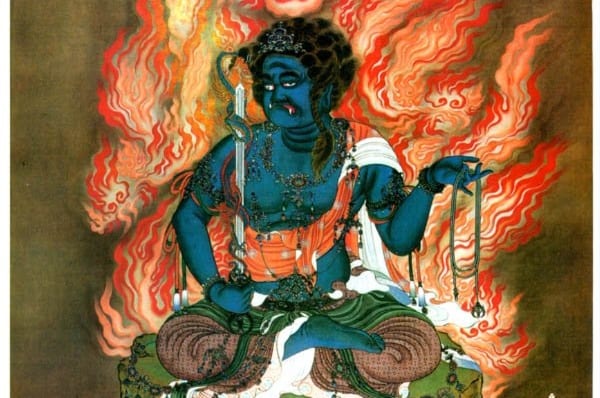
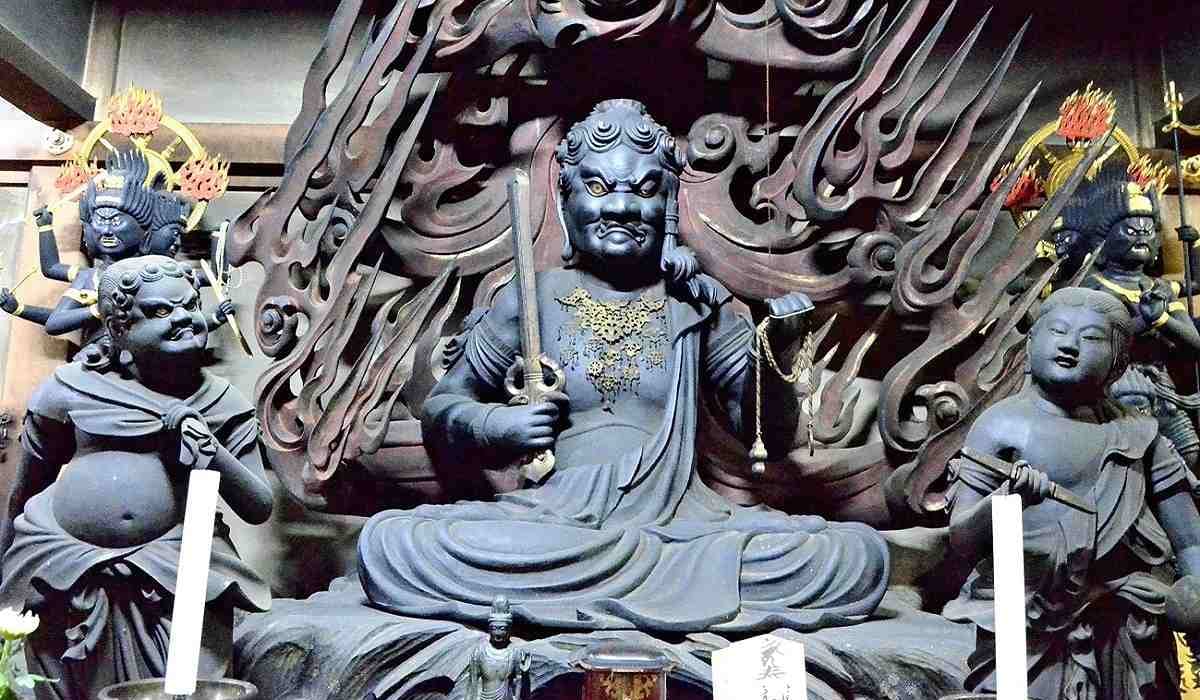
Acala is depicted with an angry face, holding a vajra sword in his right hand and a lariat in his left. One fang is pointed up, one down. One eye open, one squinting, and a side braid in his hair. He typically sits (sometimes stands) upon a rock base and is engulfed in flames. He has the physique of a round-bellied child and blue-black skin. Certain depictions also include his main two (of many) servants — Kongara (Kiṃkara) and Seitaka (Ceṭaka), though there are said to be eight such boy servants altogether, and as many as forty-eight servants overall.
He holds two objects: in his right hand, a sword (ken) — specifically the Kurikara-ken (倶利伽羅剣), a vajra sword with a dragon coiled around the blade. This sword cuts through ignorance and delusion. In his left hand, he holds a rope (ken-saku) used to bind demons and pull beings out of suffering. He is surrounded by flames — the Karura-en (迦楼羅炎), flames that consume all impurities and obstacles.
The Kurikara-ken — the sword with the coiled dragon — is one of the most recognizable symbols in Japanese tattooing and is often used as a standalone representative of Acala/Fudō. The dragon coiling around the blade is Kurikara, a manifestation of Acala himself in dragon form. The image is ancient, powerful, and carries enormous symbolic weight in both Buddhist iconography and the tattoo tradition.
Right Hand
Kurikara-ken — vajra sword with coiled dragon
Left Hand
Ken-saku — rope to bind demons and pull beings from suffering
Expression
Fierce — one eye open, one squinting; one fang up, one down
Seat
Rock — representing immovability
Halo
Karura-en — purifying flames that destroy all obstacles
Form
Round-bellied child physique; blue-black skin
What "Immovable" Actually Means
The concept of immovability at the heart of Acala's identity is not about rigidity or stubbornness. In the Buddhist context, it refers to a mind that cannot be moved by delusion, distraction, fear, or desire — a mind that remains clear and present regardless of what arises. It is the quality of a practitioner who has developed such depth of practice that external circumstances no longer destabilize them.
In the Japanese martial arts traditions — particularly in schools that draw on Zen and esoteric Buddhist philosophy — this concept is central. The ideal mental state for a martial artist is fudōshin (不動心): immovable mind. Not a mind that doesn't move, but a mind that cannot be thrown — that returns to stillness instantly, that acts without hesitation and without attachment to outcome. Miyamoto Musashi wrote about it. The Hagakure references it. It runs through the entire tradition of Japanese budo.
Marcus has been a student of Japanese Kobujutsu and Jujitsu since 1991. Fudō-Myō-O is a well-known figure in those traditions — not as an abstract religious symbol, but as a living embodiment of the mental and spiritual qualities that serious practitioners aspire to. Naming the studio Acala is a statement of that aspiration: immovable in craft, in standards, in commitment to the work.
Acala in Western Tattooing
Acala/Fudō's image found its way into Western tattooing primarily through artists who studied in Japan and brought the tradition back with them. The most significant of these was Don "Ed" Hardy — a formally trained fine artist who studied under Sailor Jerry and the legendary Horihide in Japan in the early 1970s, and returned to the United States with a deep understanding of Japanese tattoo tradition. Hardy's work, and the work of artists he influenced, introduced Japanese iconography — including Fudō — to a Western audience. His predominance in Japanese tattooing is as a centerpiece within a Horimono 彫り物 (or brazenly called irezumi 入墨) typically on one's back or chest.
Since then, Acala/Fudō's image has been widely reproduced in Western tattooing — sometimes with genuine understanding of the subject, often without. One of the most persistent misrepresentations is the labeling of Fudō as "the God of Fire" — a description that conflates his flame halo with a fire deity identity he doesn't actually have. Acala is not a fire god. The flames are a symbol of purification and the destruction of obstacles, not an elemental association.
This kind of misrepresentation is exactly what Marcus is not interested in perpetuating. When he tattoos Acala/Fudō or the Kurikara-ken, he does so with a full understanding of the iconography, the tradition, and the meaning. The subject deserves that respect.
Why It Matters for a Tattoo Studio
A studio name is a statement of identity. Acala Tattoo is named after a figure who represents immovable commitment to craft, the destruction of mediocrity, and the kind of focused, unshakeable practice that produces genuinely excellent work. That's not a coincidence. It's the whole point.
The wrathful expression, the sword, the flames — these aren't decorative. They're a reminder that real craft requires intensity, discipline, and the willingness to cut through everything that gets in the way of doing the work right. That's what this studio is built on.
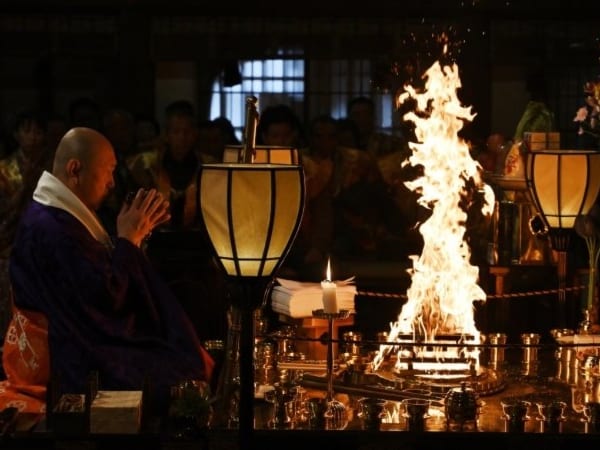
Further reading: The Shingon Fire Ritual (Goma) and its relationship to Fudō-Myō-O; Horiyoshi III's body of work; The Book of Five Rings by Miyamoto Musashi; Hagakure by Yamamoto Tsunetomo.
Ready to Start?